Maximizing Retail AI ROI: How to Feed Data Lakes for AI Predictable Inventory
|
By Phil Willis
Maximizing Retail AI ROI: How to Feed Data Lakes for AI Predictable Inventory
9:57
For modern consumer goods brands, the battle for retail market share is moving away from static dashboards and toward advanced machine learning (ML) and artificial intelligence (AI). Enterprise executives are looking to autonomous models running within Google BigQuery/Lakes, AWS, Databricks, or Azure Data Lakes to solve the oldest problem in retail: inventory optimization.
The goal is clear: utilize machine learning to eliminate the costly pendulum swing between margin-killing out-of-stocks (understocking) and bloated warehouses full of tied-up working capital (overstocking).
Yet, despite investing millions in data scientists and advanced algorithms, many enterprise retail AI initiatives hit a wall. The models deliver erratic recommendations, forcing teams to override the system manually.
The breakdown rarely stems from a flawed algorithm or poor modeling. Instead, it happens because the machine learning models are being fed unharmonized, raw data streams that distort the calculations. To achieve true inventory accuracy, organizations must shift from basic data storage to an automated, retail-intelligent preprocessing layer.
Why Raw Retailer Feeds Corrupt Machine Learning Features
In traditional business intelligence (BI), a human analyst looking at a report can intuitively catch a data anomaly—such as a missing store feed or an unmapped regional SKU code—and adjust their manual calculations.
Machine learning models do not have human intuition. They rely entirely on clean, consistent mathematical feature stores. When chaotic, disparate retailer data streams are dumped directly into a data lake without harmonization, the model views those structural data gaps as actual market behavior.
This directly triggers the data errors that ruin inventory precision:
-
Artificial Demand Drops (The Ingestion Gap):
Retailer Point-of-Sale (POS) feeds frequently arrive late, stall, or drop specific store locations. If a retailer data feed drops off for 48 hours, your demand-forecasting AI doesn’t know the file is missing; it assumes consumer demand for that item dropped to zero. The model automatically halts replenishment orders right as the product might be trending, causing immediate out-of-stocks. -
Algorithmic Safety Stock Spikes (The SKU Drift):
Retailers change item IDs, store hierarchies, and promotional classifications constantly. If an AI model ingests a modified SKU ID that hasn't been mapped back to the master product record, it reads it as a brand-new item with no history. To compensate for the sudden "unknown" risk, the inventory algorithm over-orders safety stock, cluttering warehouses with dead inventory. -
Mismatched Time Realities (The Calendar Conflict):
Multi-retailer data introduces conflicting time horizons, such as varying 4-week vs. 5-week fiscal months or differing regional promotional windows. Without native standardization, your time-series forecasting models will compare misaligned calendar blocks, leading to highly inaccurate seasonal forecasting and manufacturing projections.
VELOCITY: The Specialized Processing Factory for Your Cloud Lake
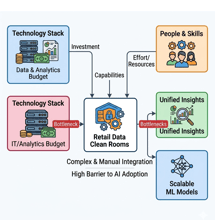
To fix this, internal IT teams often attempt to write hundreds of custom scripts, connectors, and manual data-cleaning steps inside their data platforms. However, forcing data engineers to constantly maintain custom code for ever-changing retailer formats turns your highly paid data scientists into data janitors.
Your enterprise has already made a major capital investment in scalable cloud ecosystems like Google Cloud, AWS, Databricks, or Azure Data Lakes. VELOCITY is not a replacement for those environments—it is the retail-intelligent engine that feeds them.
[Raw Disparate Retailer Data]
│ (POS, In-Transit, Warehouse Inventory, Promos)
▼
┌─────────────────────────────────────────────────────────┐
│ VELOCITY Harmonization │
│ (Automated Cleaning, SKU Mapping, Time-Alignment) │
└─────────────────────────────────────────────────────────┘
▼
[Your Cloud Data Lake: Google / AWS / Databricks / Azure / etc.]
│ (Clean, Normalized, Incremental Delta Updates Only )
▼
[Advanced Predictive Inventory & ML Forecasting Models]
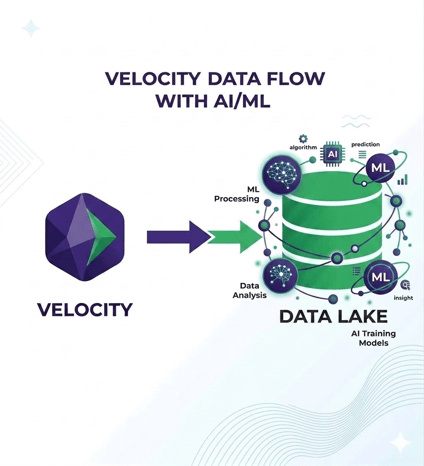
VELOCITY sits directly on the ingestion front-end of your data stack. It automatically extracts POS, inventory, and supply chain data from all your retail channels, harmonizes the formats natively, and streams clean, daily, model-ready tables directly into your existing Google, Azure, AWS, or Databricks data lake.
By automating the structural cleanup before the data reaches your feature stores, your machine learning models receive stable, reliable inputs, allowing your data science team to focus entirely on optimizing predictive performance.
30 Years of Engineered Evolution for Modern Enterprise AI
This specialized harmonization cannot be built overnight through generic ETL pipelines. VELOCITY represents more than 30 years of engineered evolution dedicated entirely to decoding how retail data is structured, how it breaks, and how it evolves over time.
Over three decades, we have integrated with global retailers and documented the exact shifts in item hierarchies, distribution networks, and digital supply chains. This deep domain intelligence is engineered directly into our platform, allowing VELOCITY to act as an automated control layer for your data lake:
- Operational Ingestion Guardrails: Automatically identifies missing or incomplete retailer files at the point of entry. By calculating and extracting only incremental changes, it ensures your data lake receives the absolute minimum volume of clean, fully mapped data required, drastically reducing cloud processing overhead.
- Dynamic Master Data Anchoring: Continuously maps drifting SKU definitions, store spaces, and multi-channel fulfillment paths back to a single source of truth.
- Semantic Standardization: Translates contrasting regional metrics, retail calendars, and retailer-specific acronyms into uniform variables.
- Model Observability Safeguards: Shields automated fulfillment and replenishment systems from making rogue ordering decisions based on stale inputs.
Generic data pipelines are designed to move data from point A to point B for historical dashboards. VELOCITY is built to deliver clean data inputs for predictive models. For consumer brands looking to turn their cloud data lakes into true inventory predictors, retail data harmonization is the foundational requirement for scalable AI success.
Fuel Your Data Lake With Clean Retail Truth
Stop letting unharmonized retailer data corrupt your machine learning models and create costly inventory imbalances. Power your Azure, AWS, Databricks, or Google forecasting engines with daily or weekly, synchronized retail clarity.
See how VELOCITY® can integrate with ML and AI models. Schedule a conversation with our team.
Retail Data Infrastructure & AI: Frequently Asked Questions
How does VELOCITY integrate with modern cloud environments like AWS, Databricks, Google Cloud Lake, or Azure Data Lakes?
VELOCITY acts as a native value multiplier for your existing modern data stack rather than a separate data silo. It sits at the ingestion stage of your data architecture. VELOCITY automatically extracts chaotic data from your retail partners, processes it through our retail-specific harmonization engine, and streams clean, uniform, model-ready tables directly into your Google BigQuery, AWS, Databricks, or Azure Data Lake. Your internal teams are freed from building or maintaining complex, custom pipelines for every single retailer format.
Why do traditional data pipelines cause inventory models to overstock or understock?
Traditional pipelines look for technical data delivery success, not retail logic errors. If a retailer sends a POS file that accidentally excludes 50 key stores, a generic pipeline accepts it as a complete file and passes it to the data lake. The demand-forecasting AI reads this sudden drop in data as a collapse in actual consumer demand and cuts off replenishment, causing massive understocking. Conversely, if a retailer assigns a new ID to an existing SKU, the AI treats it as a brand-new item and commands excessive safety stock, creating overstocking. VELOCITY's real-time operational observability catches these systemic retailer anomalies before they corrupt your machine learning feature stores.
What makes VELOCITY different from general-purpose data cleaning tools?
General-purpose tools require you to manually write, configure, and maintain every single data-cleaning rule from scratch. VELOCITY features over 30 years of built-in retail domain intelligence. Our platform natively understands how different retailers structure their sales data, calendars, promotions, and hierarchies. It automatically anchors drifting product definitions back to your true SKUs, managing the data evolution without requiring constant manual engineering from your internal IT department.
How does retailer data harmonization directly improve demand forecasting and category management?
Machine learning models rely on identifying tight, historical patterns to accurately predict future demand. If your retailer data is unharmonized, your algorithms are training on noisy, corrupted inputs. By delivering a clean, daily, synchronized stream of multi-retailer inventory and POS truth, VELOCITY gives your models the reliable data they need to identify true demand signals. This allows category managers to eliminate inventory whiplash, protect retail margins, and maintain perfect shelf availability.