
Safety Stock Optimization: Here’s Where You Need to Start
|
By Retail Velocity
Every CPG supply chain professional understands the tension. Hold too little safety stock and you risk the stockouts that erode consumer loyalty, damage retailer relationships, and hand market share to competitors.
Hold too much and you're tying up working capital in inventory that carries the risk of markdown, obsolescence, or simply sitting in a warehouse while your finance team asks uncomfortable questions about inventory turns.
Getting safety stock right isn't a matter of finding a magic formula. It's a matter of building your safety stock calculations on retail data that accurately reflects real consumer demand—at the store level, every day.
What Is Safety Stock and Why Is It So Difficult to Optimize?
Safety stock is the buffer inventory where CPG manufacturers and their retail partners maintain above average expected demand to protect against the variability that makes supply chains unpredictable. That variability comes from multiple directions simultaneously: fluctuating consumer demand, supplier lead time variability, promotional lifts that exceed forecasts, and the natural randomness of shopper behavior at individual store locations.
The challenge for most CPG analytics and supply chain teams isn't understanding what safety stock is. It's calculating the right amount of it—with enough precision to actually reduce costs and stockout risk simultaneously, rather than simply trading one problem for the other.
Traditional safety stock formulas work well in theory. In practice, they're only as reliable as the demand data that feeds them. When that data arrives weekly, covers only a portion of your retail partners, and requires days of manual processing before it can be trusted, even sophisticated safety stock models produce recommendations that are systematically less accurate than they need to be.
The Hidden Cost of Safety Stock Miscalculation
The financial impact of getting safety stock wrong is significantly larger than most CPG organizations formally measure, because the costs appear in different parts of the P&L and often aren't attributed to their root cause.
Understocked inventory produces lost sales that are invisible in your revenue reports—you see what you sold, not what you could have sold if the shelf had been full. At the store level, a stockout during a peak demand period can produce consumer-switching behavior that persists well beyond the out-of-stock event itself. Research consistently shows that a meaningful percentage of shoppers who can't find their preferred brand during a stockout will try a competitive product—possibly at another retailer—and some of them will not come back.
Excess safety stock produces its own cascade of costs: carrying costs, warehouse space consumption, the risk of promotional markdowns to move slow-moving inventory, and in categories with shorter shelf lives, outright obsolescence. When these costs are aggregated across a large SKU portfolio and multiple retail partners, the numbers become significant very quickly.
The root cause of both problems is the same: demand signal latency and data fragmentation that prevents retail analytics teams from calculating safety stock requirements with the accuracy that modern retail operations demand.
How Daily Retail Data Transforms Safety Stock Calculations
The fundamental input to any safety stock model is demand variability—specifically, how much actual consumer demand at the shelf deviates from forecast. The more accurately you measure this variability, the more precisely you can set safety stock levels that protect service levels without unnecessarily inflating inventory.
Daily, store-level point-of-sale (POS) data dramatically improves the accuracy of demand variability measurement in several important ways:
Higher data frequency reveals patterns that weekly aggregates hide.
Consumer demand at the store level is not distributed evenly across the days of the week. Shopping patterns vary significantly by day of week, by proximity to promotional events, by weather, and by local factors specific to individual trade areas. Weekly sales data averages all this variation into a single number, masking the intra-week spikes and valleys that your safety stock actually needs to protect against. Daily data exposes these patterns, enabling more precise variability calculation and more appropriately sized safety buffers.
Store-level granularity enables location-specific safety stock optimization.
An SKU that sells at a predictable, steady velocity in one market may exhibit dramatically different demand variability in another—driven by local consumer preferences, competitive dynamics, or the presence of nearby distribution centers. Setting a single safety stock level across all locations based on average demand variability systematically over-stocks low-variability locations while under-stocking high-variability ones. Daily, store-level data enables safety stock optimization at the level of granularity where the business impact actually lives.
Harmonized cross-retailer data creates a unified demand picture.
CPG manufacturers selling through multiple retail partners often struggle to build accurate demand variability models because their POS data arrives in different formats, with different product hierarchies and different reporting schedules. Without data harmonization, demand signals from different retail channels can't be meaningfully aggregated or compared—and safety stock models that span multiple retail partners become unreliable. A unified, harmonized data platform solves this structural problem, enabling consistent safety stock methodology across your entire retail footprint.
Promotional Events and Seasonal Safety Stock: Where Data Quality Matters Most
Standard safety stock models address baseline demand variability reasonably well. The harder problem—and the one where data quality has the greatest impact—is safety stock management around promotional events and seasonal demand peaks.
Promotional periods are when stockouts are most likely, most costly, and most damaging to retailer partnerships. They're also when demand variability is highest and most difficult to forecast accurately without precise historical data on promotional lift at the store and SKU level.
When your data and analytics team has access to daily POS data from prior promotional periods—at the same retailers, for the same SKUs, during comparable promotional mechanics—they can build promotional lift models that produce dramatically more accurate demand forecasts. Better forecasts mean more appropriately sized pre-promotional inventory positions, reducing both the risk of mid-promotion stockouts and the cost of excess post-promotion inventory.
Seasonal demand presents a similar opportunity. Categories with strong seasonal patterns benefit enormously from high-frequency historical data that captures not just the magnitude of seasonal peaks but the precise timing of demand acceleration and deceleration. This granularity allows supply chain teams to stage inventory more efficiently, aligning production schedules with actual consumer demand curves rather than broad seasonal estimates.
Building a Smarter Safety Stock Process
For CPG analytics teams looking to improve safety stock performance, the path forward runs through data infrastructure before it runs through formula refinement. Even the most sophisticated safety stock model will underperform if it's built on weekly aggregates, incomplete retailer coverage, or data that requires significant manual processing before it can be trusted.
The right foundation includes daily POS and inventory data from all major retail partners, harmonized into a consistent product and store hierarchy, delivered through a platform designed specifically for CPG retail data analytics. With this foundation in place, safety stock optimization becomes a data-driven, continuously improving process rather than a periodic exercise in educated estimation.
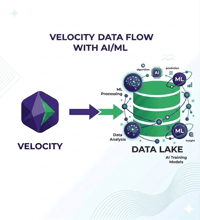
Retail Velocity's VELOCITY® retail data platform provides CPG manufacturers with exactly this foundation—daily, store-level POS and inventory data from 625+ retail adaptors, harmonized and delivered through a single platform built on 30+ years of CPG retail expertise. Supply chain and analytics teams that have made this transition consistently report improvements in both service levels and inventory efficiency—achieving the goal that every CPG operator is working toward: fewer stockouts, less excess inventory, and a supply chain that responds to actual consumer demand rather than lagging behind it.
See how VELOCITY® can transform your safety stock strategy. Schedule a conversation with our team.