From Analytics Investment to Impact: How Retail Leaders Are Closing the Data Gap
|
By Phil Willis
From Analytics Investment to Impact: How Retail Leaders Are Closing the Data Gap
11:38
The retail and consumer goods (CG) industries are no longer debating whether analytics matters—they’re racing to operationalize it.
According to the Retail and Consumer Goods Analytics Study by Consumer Goods Technology (CGT), authored by Jenny McTaggart and sponsored by Retail Velocity and others, companies are rapidly increasing investment in analytics, AI, and data infrastructure.
In fact, both retailers and manufacturers are allocating a growing share of IT budgets toward analytics, signaling a long-term commitment to data-driven decision-making.
Yet despite these investments, a disconnect remains.
The problem is not ambition. It’s execution.
The Analytics Paradox: More Investment, Limited Impact
The CGT study makes one thing clear: organizations are investing heavily in analytics—but many still struggle to extract meaningful value.
- Over half of consumer goods companies cite data integration challenges as a primary obstacle.
- Nearly half of both retailers and manufacturers report limited toolsets and budget constraints as top hurdles.
- Many organizations are still working to move beyond siloed data environments toward shared data models.
At the same time, analytics expectations are accelerating. Teams are expected to deliver insights faster, support AI initiatives, and influence real-time decisions across pricing, inventory, and supply chain operations.
This creates a familiar reality:
Data is abundant—but actionable insight remains difficult to scale.
Why the Problem Isn’t AI—It’s the Data Beneath It
Many organizations assume that advanced AI or machine learning will solve their operational challenges.
But as outlined in our recent analysis on retail AI ROI, the issue rarely stems from the models themselves—it stems from the data feeding them.
Retail data is inherently complex:
- Retailer POS feeds can arrive inconsistently or with gaps
- SKU definitions shift across partners and over time
- Promotional calendars vary between retailers
- Inventory and supply chain data lack standardization
When this fragmented data flows directly into analytics platforms or data lakes, it distorts both reporting and predictive outputs.
AI doesn’t correct these issues—it amplifies them.
This is why many organizations experience:
- Forecasting inaccuracies
- Inventory imbalances (overstocking and stockouts)
- Misaligned pricing strategies
- Increased manual intervention by analysts
Without clean, harmonized inputs, even the most advanced analytics stack struggles to deliver reliable outcomes.
The Industry Shift: From Reporting to Predictive Intelligence
The CGT study highlights a clear shift across the industry.
Organizations are rapidly moving beyond descriptive reporting toward predictive and prescriptive analytics:
- Consumer goods manufacturers are prioritizing consumer insights as a top analytics use case
- Retailers are placing increased focus on pricing strategy optimization
- Both groups are expanding their use of AI and machine learning across forecasting, promotions, and logistics
At the same time, transportation and logistics analytics are emerging as high-impact areas where both retailers and manufacturers are advancing toward more mature capabilities.
This reflects a broader transformation:
Analytics is no longer about understanding what happened—it’s about predicting what will happen next and acting on it with confidence.
But achieving this level of intelligence requires something most organizations still lack:
A unified, trusted data foundation.
Data Fragmentation: The Root Cause of Missed ROI
Despite the rapid adoption of AI, data integration remains the biggest barrier to success.
The CGT study identifies several systemic challenges:
- Difficulty integrating data from multiple sources and retail partners
- Challenges delivering insights to the right stakeholders at the right time
- Increasing complexity around data sharing and monetization between retailers and manufacturers
At the same time, the frequency of data sharing is increasing—often moving to weekly or even more frequent exchanges—placing additional pressure on systems to process and standardize data quickly.
Without a scalable approach to data harmonization, organizations fall into a common trap:
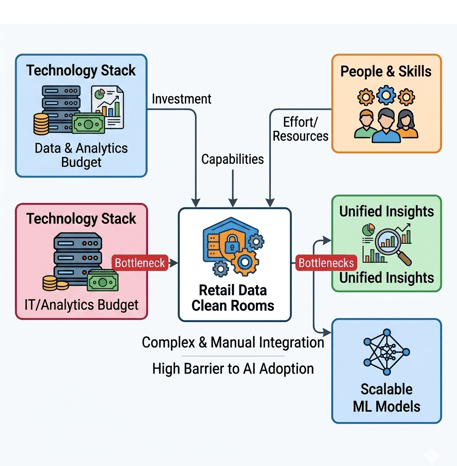
- Data engineering teams are overwhelmed by custom pipelines
- Analysts spend more time cleaning data than analyzing it
- AI outputs become inconsistent or unreliable
This is where most analytics initiatives stall—not in dashboards, but at the data ingestion layer.
How Do Retail Data Platforms Create One Source of Truth?
For consumer goods (CG) manufacturers, achieving a single source of truth isn't just about dumping files into a cloud data lake. Because different retailers share data in completely different structures, true alignment requires an automated, retail-intelligent preprocessing layer.
Modern retail data platforms establish a unified data foundation through three core technical processes:
1. Automated Multi-Retailer Data Harmonization
A single source of truth cannot exist if Walmart data speaks a different language than Target or Kroger data. A specialized platform automatically ingests disparate POS, inventory, and supply chain streams, cleansing duplicate entries and mapping varied retailer formats into a standardized data model.
2. Master Data Anchoring Across Constant Change
Product files are highly fluid. As SKU definitions evolve, store hierarchies shift, and new promotional attributes are introduced, the platform continuously maps these changes back to a consistent master registry. This prevents historical reporting gaps and keeps forecasting clean.
3. Time and Calendar Structure Alignment
Retailers operate on different fiscal and promotional calendars. To create a reliable source of truth for demand planning, the data platform synchronizes these conflicting timelines so that automated machine learning workflows can evaluate weekly and daily performance on a unified schedule.
VELOCITY: Turning Retail Data Into a Strategic Asset
This is where VELOCITY creates measurable impact.
Rather than replacing your existing cloud infrastructure, VELOCITY acts as a retail-intelligent processing layer that sits between raw retailer data and your analytics or AI environment.
Instead of relying on fragile, custom-built pipelines, VELOCITY:
-
Harmonizes Multi-Retailer Data Automatically
-
Standardizes POS, inventory, and supply chain data across retailers before it reaches your analytics systems.
-
-
Anchors Master Data Across Constant Change
-
Continuously maps evolving SKU definitions, store hierarchies, and product attributes to a consistent structure.
-
-
Aligns Time and Calendar Structures
-
Ensures forecasting models operate on synchronized timelines, eliminating distortions from mismatched retail calendars.
-
-
Delivers Clean, Model-Ready Data
-
Provides consistent, reliable inputs that enable accurate forecasting and AI-driven decision-making.
-
-
Reduces Engineering Overhead
-
Eliminates the need to maintain hundreds of custom integrations, allowing teams to focus on insights rather than data cleanup.
-
The result is a fundamental shift:
From reactive reporting to scalable, predictive intelligence—powered by clean, unified data.
Unlocking Analytics Maturity and Competitive Advantage
The CGT study finds that retailers increasingly view data quality as a competitive advantage, while manufacturers continue to identify gaps in analytics capabilities.
VELOCITY directly addresses both challenges:
- Improves data quality at scale
- Simplifies complex data environments
- Accelerates time-to-insight
This becomes even more critical as AI adoption grows.
The study shows that both retailers and manufacturers are rapidly increasing their use of AI and generative AI, while also citing data quality and output reliability as key concerns.
Without a strong data foundation, AI initiatives struggle to scale.
With it, they become a true competitive differentiator.
From Investment to Impact
The findings from the CGT study point to a clear conclusion:
The organizations that realize value from analytics will not be those that invest the most—but those that solve their data challenges first.
Companies that successfully:
- Eliminate data silos
- Standardize multi-retailer inputs
- Deliver clean, unified data into analytics environments
…are the ones that will unlock the full potential of AI and advanced analytics.
The Path Forward
As analytics strategies continue to evolve across retail and consumer goods, one principle remains constant:
Predictive intelligence requires a reliable data foundation.
VELOCITY was built specifically to address this challenge—bringing decades of retail data expertise into modern cloud and AI ecosystems.
For organizations ready to move beyond fragmented analytics and toward measurable, AI-driven performance, the path is clear:
Start at the source. Clean the data. Then unlock the value.
Sources:
- Consumer Goods Technology (CGT), Retail & Consumer Goods Analytics Study, authored by Jenny McTaggart and sponsored by Retail Velocity and others.
Retail Analytics & Data Integration: Frequently Asked Questions
According to the CGT Study, what is the biggest barrier preventing consumer goods manufacturers from scaling AI and analytics?
The Retail and Consumer Goods Analytics Study reveals that 51% of consumer goods manufacturers cite the inability to integrate data from multiple sources as their primary operational hurdle. While organizations are aggressively increasing their AI adoption and analytics budgets, raw multi-retailer data streams remain siloed and unharmonized. VELOCITY directly eliminates this barrier by acting as an automated, retail-intelligent ingestion layer that seamlessly unifies disparate retailer data before it ever hits your data lake or AI models.
Why do traditional cloud data lakes struggle to deliver accurate demand forecasting and pricing intelligence?
Traditional cloud data lakes are excellent at storing data, but they lack built-in retail domain logic. The CGT study notes that companies are moving fast toward predictive intelligence, yet they are held back by fragmented retailer POS feeds, shifting SKU definitions, and mismatched fiscal calendars. When these inconsistent variables flow raw into a data lake, they corrupt your machine learning feature stores, causing costly forecasting inaccuracies and inventory imbalances. VELOCITY automatically normalizes these specific retail complexities at the point of ingestion.
With data sharing frequency increasing to a weekly or daily cadence, how should brands adapt their data architecture?
Retailers are sharing critical inventory, POS, and promotional performance data more frequently than ever, and 60% now monetize or charge for this data. To capture maximum ROI on these expensive data streams, consumer brands must move past slow, manual file downloads and descriptive reporting. VELOCITY transforms these rapid, incoming streams into continuous, model-ready daily features. This ensures that your automated fulfillment workflows, machine learning models, and category managers operate on real-time synchronized truth to eliminate costly out-of-stocks.