Making NielsenIQ Data Work: Create a Unified NIQ Retail Data Pipeline
|
By Retail Velocity
Making NielsenIQ Data Work: Create a Unified NIQ Retail Data Pipeline
6:04
For most CPG and retail analytics teams, NielsenIQ (NIQ) is already a foundational data source. The challenge is no longer access—it’s operationalizing that data alongside retailer-direct feeds and internal systems in a way that is scalable, governed, and reliable.
The Challenge: Data Exists, But It’s Fragmented
NIQ provides one of the most comprehensive views of consumer purchasing behavior globally, covering over 90 countries and trillions in tracked spend. However, its delivery model—primarily scheduled, file-based extracts—introduces complexity downstream.
Organizations commonly face questions such as:
- Where should syndicated data land?
- How is it validated and monitored?
- How does it align with Walmart, Amazon, or Target data structures?
- How do we avoid creating a disconnected “side dataset”?
These are not licensing issues—they are operational challenges that directly impact data usability and trust.
The Role of TIBCO: Secure and Automated Data Movement
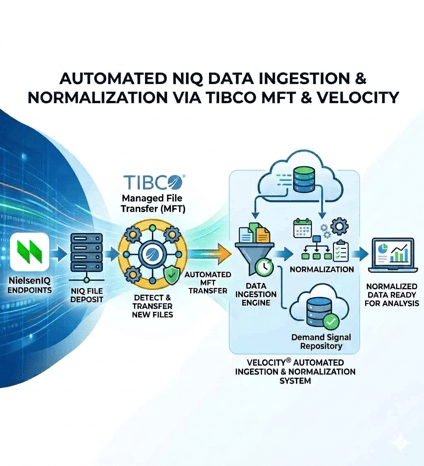
TIBCO Software plays a critical role in solving the data movement problem. Its Managed File Transfer (MFT) capabilities act as a secure, automated bridge between NIQ and downstream systems like VELOCITY®.
How the Integration Works
A typical enterprise workflow looks like this:
- NIQ Data Delivery
NIQ publishes syndicated datasets via secure endpoints (SFTP, FTPS, HTTPS), often hosted on TIBCO MFT servers. - TIBCO Orchestration
TIBCO automatically:- Detects new file availability (event-driven triggers)
- Transfers files securely
- Ensures delivery with checkpoint/restart capabilities
- VELOCITY Ingestion
Retail Velocity receives the data and processes it within its unified data pipeline.
This “set-it-and-forget-it” model is widely considered a best practice for high-volume retail data environments.
Where VELOCITY Adds Value: From Ingestion to Integration
While TIBCO ensures reliable delivery, VELOCITY is where the data becomes usable.
Rather than treating NIQ as a standalone dataset, VELOCITY integrates it into a broader enterprise data model that includes:
- Walmart POS and Scintilla data
- Amazon Vendor/Seller data
- Target and other retailer feeds
- Internal ERP and inventory systems
Key Capabilities
1. Automated Ingestion Across Sources
VELOCITY continuously collects and updates data from NIQ and retailer feeds without manual intervention.
2. Data Normalization
Product hierarchies, retailer structures, and calendars are standardized across all datasets—eliminating the need for duplicate mapping logic.
3. Data Governance and Separation
Licensed NIQ data remains properly governed while still being analytically aligned with other sources.
4. Unified Data Model
Downstream systems—BI tools, analytics platforms, ML platforms, AI workflows, and data science workflows—consume a single, harmonized dataset rather than fragmented inputs.
Business Impact: From Data Silos to Actionable Insights
When NIQ, TIBCO, and VELOCITY are deployed together, organizations gain:
- Reduced Operational Risk
Eliminates manual file handling and ad hoc pipelines. - Improved Data Consistency
Aligns syndicated and retailer data into a single version of truth. - Faster Time to Insight
Analysts spend less time preparing data and more time generating value. - Scalable Architecture
Supports growth across additional retailers, geographies, and data providers.
Why This Approach Remains the Enterprise Standard
Although newer API-based delivery models are emerging, file-based transfer via TIBCO MFT remains the preferred approach for many enterprises due to:
- Proven reliability for large datasets
- Strong security and compliance (encryption, audit logs)
- Event-driven automation capabilities
- Compatibility with existing infrastructure
Final Perspective
NIQ data is extremely valuable—but only when it is fully integrated into the broader retail data ecosystem.
By combining:
- NIQ’s market intelligence
- TIBCO’s secure data orchestration
- VELOCITY’s unified data platform
organizations move beyond isolated datasets and toward a scalable, enterprise-grade analytics strategy.
The result is not just better data access—but better business decisions.
Questions and Answers:
How can CPG companies integrate NielsenIQ (NIQ) data with retailer-direct feeds?
Answer: Integrating NIQ data with retailer-direct feeds can be achieved through a unified data pipeline using a platform like VELOCITY. This involves automating the ingestion of file-based NIQ extracts and harmonizing products and stores to create a single source of truth.
What is the best way to automate NielsenIQ data ingestion and normalization?
Answer: The industry standard for high-volume retail environments is an automated, event-driven pipeline. VELOCITY facilitates this by automatically ingesting data delivered via TIBCO Managed File Transfer (MFT). Once ingested, VELOCITY performs automated normalization—standardizing product hierarchies, retailer structures, and calendars across all datasets—to eliminate manual mapping and ensure NIQ data is immediately ready for cross-retailer analysis.
Why is file-based data transfer via TIBCO still preferred over APIs for NIQ data?
Answer: File-based transfer via TIBCO MFT remains the enterprise standard for retail data. It offers proven reliability for massive datasets, robust security features, event-driven automation, and "checkpoint/restart" capabilities.
How do you solve the challenge of fragmented retail data in enterprise analytics?
Answer: Companies should move from simple "ingestion" to full integration within a unified data model. Using VELOCITY allows licensed NIQ data to remain governed while being analytically aligned with other sources, resulting in a scalable architecture.
See how VELOCITY® can integrate NIQ into your Unified Retail Pipeline. Schedule a conversation with our team.